TOKYO, JAPAN, August 07, 2026 /24-7PressRelease/ — Offworld Industries, an American space construction company developing technologies for large-scale orbital infrastructure, today announced that CEO John Blincow has returned from Tokyo following an exploratory meeting at Kajima Corporation’s global headquarters with representatives from Japan’s space, construction, travel, and life-support communities.
The meeting included representatives associated with Kajima’s space-related initiatives, JAXA — the Japan Aerospace Exploration Agency — Nippon Travel Agency, and technical specialists focused on the systems required for future human activity in space. While no formal joint venture, procurement decision, or commercial partnership has been announced, Offworld Industries said the discussion reflects a larger shift now underway across the global space economy: space development is moving beyond launch and spacecraft toward the construction of durable, large-scale infrastructure.
“Point-to-point space transportation, lunar tourism, orbital hospitality, orbital data centers, fuel depots, spacecraft maintenance yards, orbital manufacturing facilities, and rotating habitats all point toward the same underlying requirement,” said John Blincow, CEO of Offworld Industries.
“Humanity needs construction methods capable of building large structures in space. That is the problem Offworld Industries was created to solve.”
The Tokyo meeting occurred at a moment of growing international interest in commercial space travel, artificial-gravity habitats, orbital facilities, and permanent infrastructure beyond Earth. Nippon Travel Agency has publicly advanced space travel initiatives through its Galaxy Project, while Kajima and Kyoto University have publicly explored artificial-gravity habitat concepts, including Lunar Glass, for future lunar habitation. These developments point to an emerging convergence between terrestrial infrastructure expertise and the next generation of space development.
“Japan has a powerful combination of capabilities: construction, robotics, space science, transportation, hospitality, precision engineering, and long-term infrastructure thinking,” Blincow said. “Tokyo was an ideal setting for this conversation because the future of space is not only about launch vehicles. It is about what we build after we get there.”
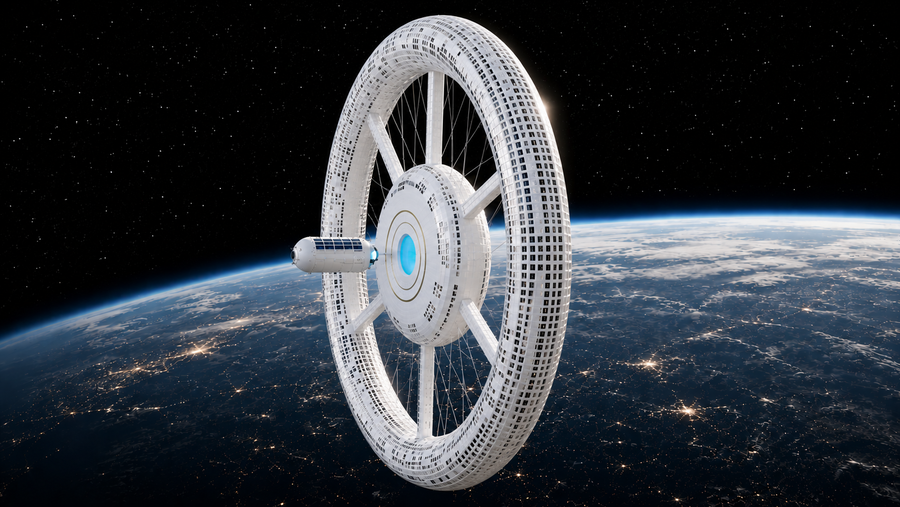
Offworld Industries’ technology roadmap focuses on construction systems and architecture for large rotating space stations and related orbital platforms. The company believes rotating structures capable of producing artificial gravity will be essential for longer-duration human activity in orbit and beyond, while modular space construction could support a new generation of crewed and human-tended facilities.
“Large rotating stations are moving from the realm of speculation toward practical infrastructure planning,” Blincow said. “The design space now includes orbital hotels, crew-serviceable data centers, fuel depots, maintenance facilities, logistics hubs, and manufacturing platforms. The limiting question is no longer whether these destinations are imaginable. The question is how they can be built safely, economically, and at scale.”
Offworld noted that orbital data centers are becoming an increasingly active area of analysis as terrestrial data infrastructure faces growing constraints around power, cooling, land use, permitting, and resiliency. Most orbital data center concepts under discussion today assume uncrewed or minimally serviced satellite platforms.
Offworld is exploring a different path: larger, human-tended orbital facilities that could combine data infrastructure with inspection, maintenance, upgrade, and repair capability.
“Space-based compute will not replace terrestrial data centers,” Blincow said. “But for certain workloads, orbital infrastructure may eventually become a serious complement to Earth-based systems. If that happens, the ability to service, expand, and reconfigure those assets in orbit could become a major architectural advantage.”
The company emphasized that future space construction will require collaboration across aerospace, civil engineering, robotics, energy systems, environmental control and life support, transportation, finance, tourism, advanced manufacturing, and digital infrastructure. Offworld views space construction not as a departure from terrestrial industry, but as its next frontier.
The Tokyo meeting did not create a formal consortium. However, Offworld Industries said it supports the formation of an international space construction ecosystem capable of connecting the disciplines required for permanent human expansion beyond Earth.
“Every serious space economy eventually becomes a construction economy,” Blincow said. “Launch gets us to orbit. Construction determines what we can do once we arrive.”
About Offworld Industries
Offworld Industries is an American space construction company developing technologies, architectures, and systems for large-scale orbital infrastructure. The company’s work focuses on the construction of rotating space stations and related orbital platforms that may support future applications including habitats, hotels, fuel depots, spacecraft maintenance facilities, manufacturing platforms, logistics hubs, and human-tended orbital data centers.
Website: https://www.offworldindustriescorp.com
—
For the original version of this press release, please visit 24-7PressRelease.com here
Legal Disclaimer: The content on this page is syndicated from independent third-party providers. Kyrion Media makes no warranties or representations regarding the accuracy, completeness, legality, or reliability of the information, including text, images, videos, or licenses. If you are affiliated with this content or have any complaints, copyright concerns, or requests for removal, please contact us at retract@kyrionmedia.com with the specific URL of the content in question. We will review and address valid requests promptly.